

BatteryMINDer vs. NOCO Genius for Your RV Battery Charger: Why an AC Charger is the Wrong Approach for a Motorhome
Share
Your RV Battery Charger is Important
When it comes to keeping a motorhome chassis battery alive during storage, two names often come up: NOCO and BatteryMINDer. Both brands manufacture cost effective AC-to-DC battery chargers designed to prevent sulfation and extend battery life.
If you are currently choosing between the NOCO Genius and a BatteryMINDer, you are asking the right questions: "How do I stop my starter battery from dying in storage?" However, for a motorhome owner, both of these tools share a fundamental flaw. They rely on an AC wall outlet—a luxury you don't always have when your rig is in a storage lot, or parked off-grid.
What Do AC Wall Chargers Actually Do?
Both the NOCO Genius and BatteryMINDer series are "smart chargers." They use a multi-stage charging profile to maintain a battery and keep it charged. These are excellent tools for a car parked in a garage next to a power outlet. But a motorhome isn't an average car, and a storage lot isn't a garage.
The Efficiency Trap: Why AC Chargers Fail the "RV Test"
If you are considering plugging a NOCO or BatteryMINDer into your RV’s internal AC outlets while in storage, you are entering an electrically inefficient cycle.
To run an AC charger from your RV's own power, your system must:
-
Take DC power from your House Batteries.
-
Use an Inverter to convert that DC to AC (losing 10–15% energy to heat), and the inverter consumes power just by being ON.
-
Plug in the NOCO or BatteryMINDer, which converts that AC back to DC to charge the chassis battery (losing another 10–20%).
You are essentially "burning" 30% of your energy just to move power from one battery to the other. According to technical standards for power conversion, this "double inversion" is the least efficient way to manage energy in a mobile environment.
Both the BatteryMINDer and NOCO have another issue. They are not designed to be permanently installed in your motorhome. These are designed for temporary use scenarios.
A Smarter Alternative: The House2Start DC-to-DC Advantage
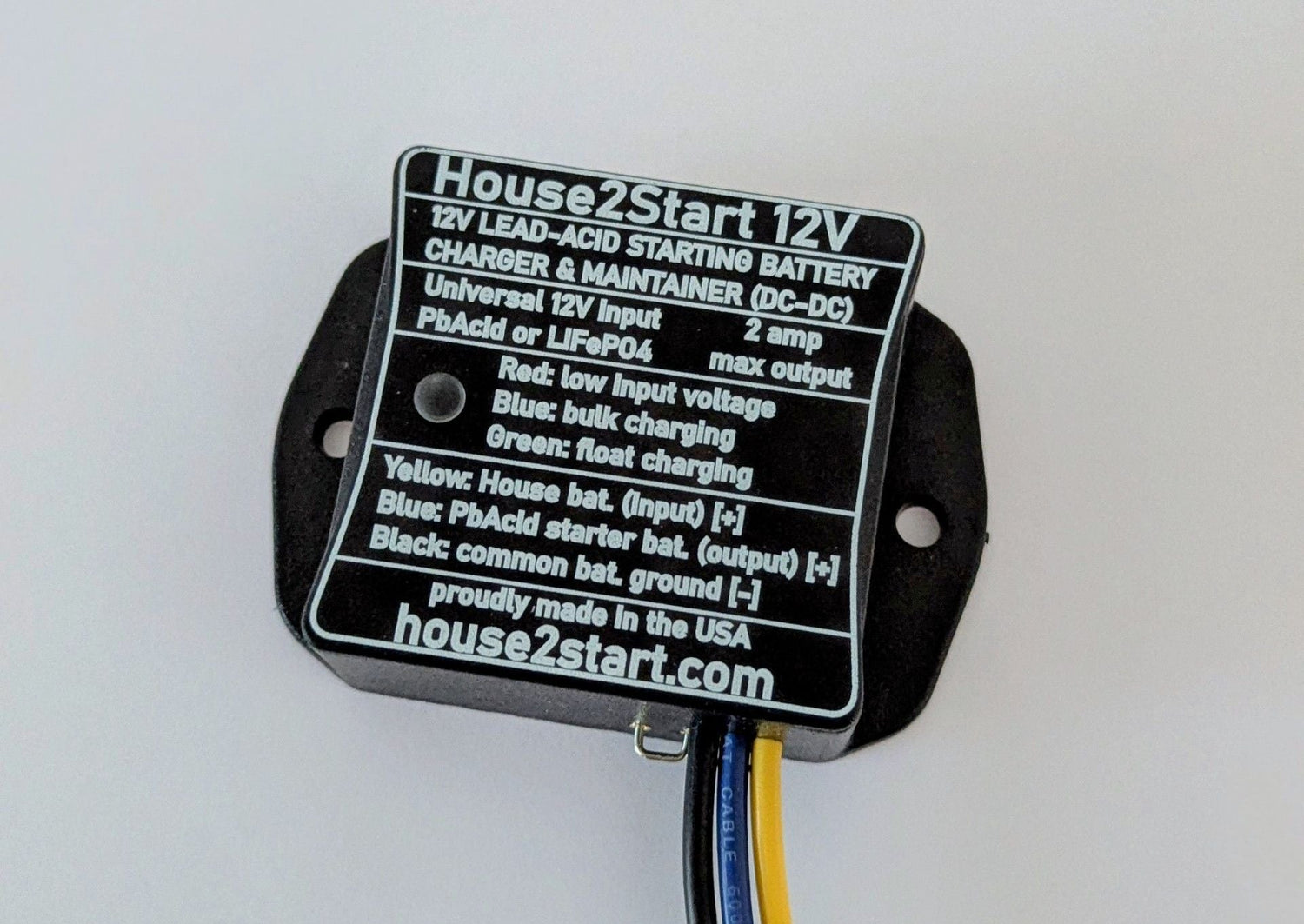
Why convert power twice when you can move it once? The House2Start is designed specifically to solve the problem that NOCO and BatteryMINDer cannot: permanent, efficient, off-grid maintenance.
|
Feature |
NOCO / BatteryMINDer |
House2Start |
|
Multi Stage Smart Charging |
✅ Yes |
✅ Yes |
|
Input Requirement |
🔌120V AC |
🔋12V DC (House Battery) |
|
Conversion Loss |
⚠️ High (~30% via Inverter) |
✅ Low (Direct DC Transfer) |
|
Off-Grid Capable |
⚠️ Not designed to be |
✅ Yes |
|
Installation |
Temporary-Clips |
Permanent-Hardwired |
Why House2Start Wins for Motorhomes
House2Start uses the electrical infrastructure you already have onboard. Whether you have a massive Lithium bank or a simple pair of 6V lead-acid house batteries, House2Start pulls a tiny 2-amp current to keep your engine battery topped off.
With Solar Panels or Shore Power, House2Start turns your house power system into a maintenance system for your engine battery. While the sun or shore charges your house batteries, House2Start ensures that energy reaches the chassis battery too. No AC plugs, no extension cords, and no "Battery Boost" button required.
The Verdict
The NOCO Genius and BatteryMINDer are great for your lawnmower or your classic car in the garage. But your motorhome is a sophisticated DC ecosystem. Don't force it to rely on an AC "Band-Aid."
Stop the cycle of conversion loss and dead batteries. Switch to a dedicated DC-to-DC maintainer like House2Start. Shop now.